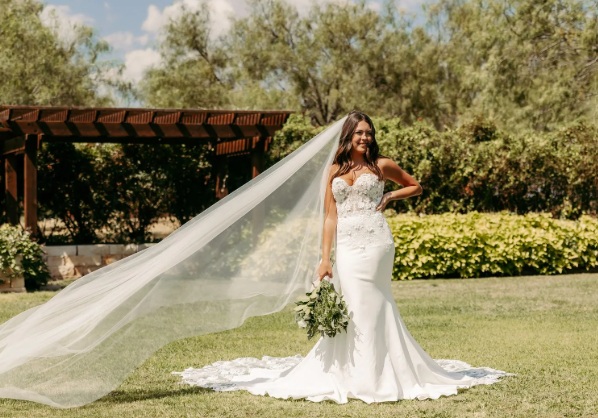
Choosing a veil length comes down to three questions. What is the silhouette of your dress? How formal is your venue? And how much presence do you want the veil to have in your photos? Shorter lengths, from birdcage to elbow, suit relaxed venues and dresses with detail you want on show. Fingertip flatters almost everyone, which is why stylists treat it as the default. Chapel and cathedral lengths are for brides who want the veil to be part of the drama rather than an accessory to it.
Get the length right and the veil melts into the overall look. Get it wrong and it cuts your silhouette at exactly the wrong point. Here is how to avoid that.
The standard veil lengths at a glance
Names vary slightly between makers, but the industry works to roughly these measurements:
| Length | Approximate drop | Where it falls | Best for |
| Birdcage | 4 to 9 inches | Cheekbones to chin | Vintage styling and civil ceremonies |
| Shoulder | Around 20 inches | Shoulders | Dresses with waist or back detail you want visible |
| Elbow | 25 to 28 inches | Elbows | Ball gowns, since it ends before the skirt flares |
| Fingertip | 36 to 40 inches | Fingertips | Almost every dress and venue |
| Waltz or ballet | 48 to 54 inches | Mid-calf | Length without a train to manage |
| Chapel | Around 90 inches | Sweeps the floor | Formal ceremonies and classic photography |
| Cathedral | 108 inches and up | Extends past the train | Grand venues and maximum impact |
One thing the chart cannot show: the drop is measured from where the comb sits, so your height and hairstyle change where any veil actually ends on you. A fingertip veil pinned into a low bun lands lower than the same veil worn at the crown. For a fuller breakdown, including how to measure before you order, this guide to weddling veil lengths includes a chart you can check against your own measurements.
Start with the dress, not the veil
A veil should end where your dress can take it. In practice:
- If the bodice is beaded or corseted, avoid lengths that stop right at the waist, because the veil edge will sit on top of the detail. Go shorter, or go clearly past it.
- If the skirt is the feature, elbow length works beautifully because it finishes before the skirt begins to flare.
- If the back is the feature, an illusion panel or a row of buttons, choose a sheer single tier that lets the detail read through, or a short length that ends above it.
- If the dress is clean crepe or satin, the veil can do the talking. This is where chapel and cathedral lengths earn their place.
The venue sets the ceiling
A cathedral veil in a register office reads as costume. A birdcage in a cathedral disappears. Match the scale of the veil to the scale of the room and the length of the aisle, since a long veil needs a long walk to stretch out behind you.
Outdoor brides should think about wind. Light tulle catches air, and while some brides love that movement in photos, it can be a fight on an exposed beach or hilltop. If wind worries you, stay at waltz length or shorter, or ask your veil maker about a weightier edge.
Proportion does the quiet work
Petite brides usually look best in lengths that end above the waist or go all the way to the floor. The in-between lengths, especially waltz, can visually shorten the frame. Taller brides carry every length well and can afford the extra drama of a royal cathedral drop.
Also watch the gap between veil and hem. A veil that ends within a few inches of the dress hem, without matching it, looks like a measuring error. Either finish clearly above the hem or extend clearly past it.
The mistakes stylists see most often
- Ordering the veil before the dress. The dress decides the length, never the other way around.
- Forgetting the hairstyle. Comb position moves every measurement, so settle your hair trial first if you can.
- Ignoring the blusher. A blusher adds a second, shorter layer over the face and changes how the front of the veil sits after the ceremony.
- Guessing at color. White against ivory is obvious in photographs, so always check the veil against a swatch of your dress in daylight.
- Ending the veil at a feature line. The hem of the veil should never sit exactly where the dress changes, at a seam, a beading line, or the top of a flare.
Made-to-order studios, such as Tara Bridal, cut the same designs across several lengths, which lets you choose the style you love first and confirm the drop after your dress fitting.
See also: Age Verification: A Complete Guide for Fintech Companies
Quick answers to common veil length questions
Can I wear a long veil with a short dress? Yes, and it is one of the most photographed pairings of recent seasons. The contrast looks intentional, especially with tea-length and mini dresses.
Do I have to take the veil off for the reception? No rule says so. Most brides remove chapel and cathedral lengths after photos for practical reasons, while fingertip and shorter can stay in comfortably all night.
What length should I choose if my dress has a train? Either finish above the waist or choose a veil that extends past the end of the train. A veil that stops partway down a train interrupts the line you paid for.
What if I am torn between two lengths? Size up. A slightly longer veil drapes; a slightly short one looks like a mistake.
