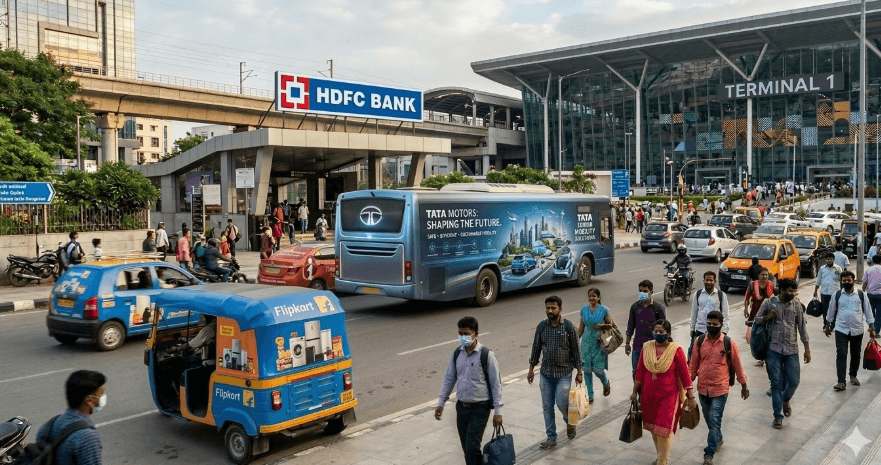
People spend a surprising amount of time traveling. They commute to work, run errands, wait for buses, ride trains, and sit in traffic. That time creates an opportunity for brands to appear in a setting where audiences are already paying attention to their surroundings.transit advertising places a message on or around public transportation, helping businesses build awareness through repeated, location-based visibility.
Unlike many digital ads that can be skipped in seconds, transit ads become part of the daily environment. A well-placed bus wrap, station poster, or taxi ad can reach the same person multiple times each week. The challenge is not simply buying space; it is creating a message that is clear, memorable, and relevant to people who are moving quickly.
What Is Transit Advertising?
Transit advertising is a form of out-of-home marketing that uses transportation systems and commuter spaces to display brand messages. It can include ads on buses, trains, taxis, trams, ride-share vehicles, transit shelters, benches, terminals, and station platforms.
The format works especially well for local businesses, events, retail brands, restaurants, healthcare providers, colleges, and service companies that want to reach people within a specific city or region. It can also support national campaigns when placed across several major transit markets.
The major advantage is frequency. A commuter who sees the same bus ad each morning may not act immediately, but recognition grows over time. When that person later needs the advertised product or service, the brand is more likely to come to mind.
Transit campaigns also reach people across different age groups, professions, and lifestyles. A single route may pass through residential neighborhoods, business districts, shopping areas, schools, and entertainment zones. This gives advertisers exposure that is broader than many hyper-targeted online campaigns.
How Transit Advertising Works in Real-World Marketing
Transit advertising is most effective when it supports a clear business goal. That goal may be brand recognition, foot traffic, event attendance, app downloads, website visits, or product launches.
For example, a new fitness studio could advertise on buses that travel near office districts and apartment complexes. Instead of listing every class and membership option, the ad could use a short message such as “Your Workout Is Five Minutes Away,” followed by the neighborhood name and a simple call to action.
A restaurant opening a second location can use transit shelters near the new branch. The message might focus on one recognizable menu item, the opening date, and a location cue. This is more useful than trying to explain the entire restaurant concept on a small poster.
Large brands use transit media differently. A streaming service may promote one visually striking show across train stations, while a consumer goods company may use bus exteriors to create broad citywide awareness. In both cases, the audience should understand the message in a few seconds.
A Step-by-Step Strategy for an Effective Campaign
Define the Goal Before Choosing the Format
Start with one primary objective. Trying to promote a brand, announce a sale, collect leads, and drive app downloads in one ad usually creates clutter.
Choose a goal that can guide every campaign decision. If the goal is local awareness, prioritize high-traffic routes and visibility. If the goal is store visits, select transit spaces near your location and include a direct reason to visit.
A simple campaign objective could be: “Increase awareness of our new downtown clinic among weekday commuters.” This makes the audience, geography, and purpose clear.
Understand the Audience’s Travel Pattern
Transit media is not just about population size. It is about where people travel, when they travel, and what they are likely doing when they see the ad.
Office commuters may respond to coffee, lunch, financial services, wellness products, and after-work entertainment. University routes may be suitable for affordable food, mobile plans, education services, and retail offers. Airport routes can work well for hotels, travel services, car rentals, and premium local experiences.
Ask practical questions before selecting placements:
- Which neighborhoods does the route serve?
- Is the audience commuting, shopping, studying, or traveling?
- What time of day will they see the message?
- Can they act on the offer nearby or later on their phone?
Match the Creative to Viewing Time
Most transit ads are viewed quickly. That means the design should communicate the main idea almost instantly.
Use one strong headline, one visual focus, and one clear next step. A crowded ad with long paragraphs, tiny contact details, and multiple offers will be difficult to process from a moving vehicle or busy station.
For a bus exterior, brand name, headline, and visual should be readable from a distance. For a shelter poster, you can add slightly more detail because people may be standing nearby while waiting. Digital station screens can work well for short animated messages, but the message should still be understandable without sound.
Make Measurement Part of the Plan
Transit advertising is often used for awareness, but that does not mean results cannot be measured. Use a dedicated landing page, memorable promo code, campaign-specific phone number, or QR code when appropriate.
For instance, a local retailer could use “RIDE10” as a transit-only discount code. This will not capture every conversion, but it gives the marketing team a clear signal of direct response. You can also compare website traffic, branded searches, store visits, and sales trends during the campaign period.
Common Transit Advertising Mistakes
One frequent mistake is trying to say too much. A transit ad is not a brochure. If viewers cannot understand the main point while walking past or driving by, the creative needs simplifying.
Another problem is choosing locations based only on low cost. A cheaper placement is not valuable if it does not reach people who are likely to care about the offer. Route relevance matters more than simply having a large number of impressions.
Brands also sometimes forget operational details. Transit ads may be exposed to weather, blocked by traffic, or viewed from different angles. Check artwork specifications, colors, contrast, and placement dimensions before approving a design.
Finally, do not judge the campaign too quickly. Transit is often a cumulative medium. The value comes from repeated exposure, so campaigns generally need enough time for people to notice, remember, and respond.
Expert Tips for Better Results
Keep the message locally relevant whenever possible. Mentioning a neighborhood, landmark, or nearby location can make an ad feel more useful and less generic. A message like “Fresh Lunches Near Central Station” has more immediate value than “Great Food for Everyone.”
Use contrast and simple typography. Viewers should be able to understand the message at a glance, even in poor weather or crowded conditions. Test the design by viewing it from several feet away on a phone screen. If the headline is hard to read there, it will likely be hard to read in public.
Coordinate transit media with your wider marketing. The same headline, offer, or visual can appear on social media, local search ads, and in-store displays. This consistency helps people connect what they saw during their commute with what they see online later.
Before launching a campaign, reviewing your landing page and local visibility can prevent wasted attention. A tool such asAudEsto can help agencies and businesses review a campaign landing page, identify technical SEO issues, and create branded audit reports for clients.
See also: Understanding Top Commercial Fleet Leasing Options for Austin Businesses
Conclusion
Transit advertising remains a powerful way to reach people in the real world, especially when the message fits the route, audience, and moment. Its strength is repeated visibility rather than one-click conversions alone.
The best campaigns are simple, location-aware, and easy to understand in seconds. Set a focused objective, choose routes with intention, create clear visuals, and measure what happens after people see the message. With that approach, transit media can turn everyday travel into meaningful brand exposure.
